Trump's birthright citizenship challenge meets skepticism from Supreme Court justices
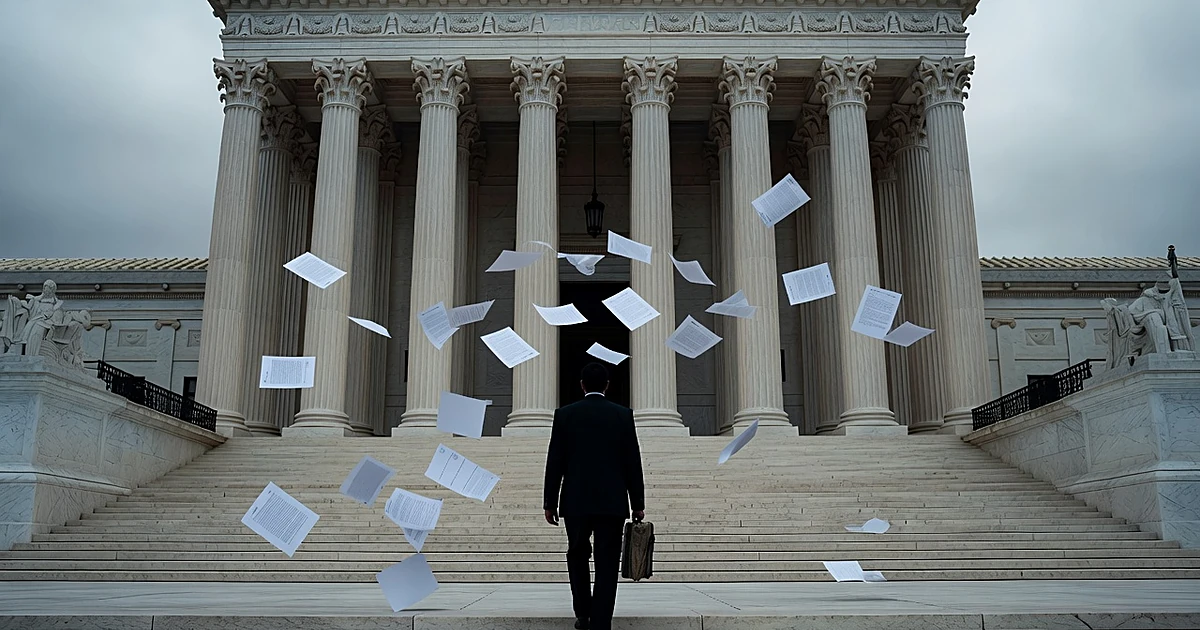
The Trump administration's effort to end birthright citizenship for the children of illegal immigrants ran into pointed questions from Supreme Court justices, exposing the steep constitutional climb the executive order faces even before a Court that has shown willingness to defend broad presidential authority on other fronts.
The case marks one of the most consequential immigration disputes to reach the high court in years, and the early signals suggest the administration may not find the friendly reception it has enjoyed in other recent clashes over executive power.
At issue is a Trump executive order that would deny automatic U.S. citizenship to children born on American soil to mothers who are in the country illegally or on temporary visas, a direct challenge to the long-standing interpretation of the Fourteenth Amendment's Citizenship Clause. The oral arguments drew skeptical questioning from justices across the ideological spectrum, raising doubts about whether the administration can rewrite more than a century of constitutional understanding through executive action alone.
The constitutional stakes
The Fourteenth Amendment states that "all persons born or naturalized in the United States, and subject to the jurisdiction thereof, are citizens of the United States." Since the Supreme Court's 1898 decision in United States v. Wong Kim Ark, that language has been read to guarantee citizenship to virtually everyone born on U.S. soil, regardless of their parents' immigration status.
The Trump administration argues for a narrower reading. Its position holds that "subject to the jurisdiction thereof" should exclude children of mothers who lack lawful permanent status, a reading that would represent a dramatic departure from existing precedent and affect hundreds of thousands of births each year.
That argument has long had supporters in conservative legal circles. But translating it into enforceable policy through an executive order, rather than through legislation or a constitutional amendment, adds a separate layer of difficulty. Several justices appeared to press on both points, the textual question and the procedural one.
The Court has recently grappled with the boundaries of executive authority in other high-profile cases. A sharp 6-3 ruling striking down Trump's tariff actions showed that even justices sympathetic to broad presidential power have limits. The birthright citizenship case could test those limits again.
Why skepticism matters here
Skeptical questioning at oral argument does not always predict the outcome. Justices sometimes press hardest on the side they ultimately favor, testing the strength of the arguments. But the breadth of the pushback, reportedly coming from both liberal and conservative members of the bench, suggests the administration faces a difficult path.
Lower courts have already blocked the executive order. Federal judges in multiple jurisdictions issued injunctions shortly after the order was signed, finding that the Fourteenth Amendment's text and the Wong Kim Ark precedent left little room for the administration's interpretation.
The administration appealed, and the case moved quickly through the system, part of a broader pattern in which the Court's emergency docket has swelled with fast-tracked disputes over presidential power. That pattern has drawn criticism from legal observers on both sides who worry the justices are being asked to decide major constitutional questions on compressed timelines.
The surge in emergency docket cases has reshaped the Court's recent terms, forcing justices to weigh in on sweeping policy disputes without the benefit of full briefing and lower-court development.
The policy reality
Birthright citizenship is not an abstract legal question. It touches the lives of families, hospitals, state agencies, and school systems across the country. If the executive order were upheld, children born in the United States to illegal immigrants or visa holders would lack citizenship at birth, creating a new class of people born on American soil with no clear legal status.
Supporters of the order argue it would remove a powerful incentive for illegal immigration. They point to the phenomenon sometimes called "birth tourism" and contend that the framers of the Fourteenth Amendment never intended to grant automatic citizenship to the children of people who entered the country unlawfully.
Opponents, including some conservative legal scholars, counter that the text is plain, the precedent is settled, and the proper vehicle for change is a constitutional amendment, not a presidential pen stroke. They warn that allowing one administration to redefine citizenship by executive order would set a precedent far more dangerous than the policy problem it aims to solve.
The tension between those positions has simmered for decades. What makes this moment different is that a sitting president chose to force the question, and the Supreme Court agreed to hear it.
Executive power under the microscope
The birthright citizenship case arrives at a Court already engaged in a broader reckoning over the reach of presidential authority. The justices' recent willingness to check executive action, even action taken by a president many of them were appointed by, has surprised observers who expected a more deferential posture.
Justice Gorsuch, in particular, has emerged as a voice warning against unchecked executive power, a theme that has surfaced repeatedly in the Court's recent work on trade and regulatory authority.
Whether that same instinct carries over to immigration remains to be seen. The administration has argued that immigration enforcement is a core executive function and that the president has broad latitude to define the terms of entry and status. But birthright citizenship is not an enforcement question, it is a constitutional one, rooted in the text of an amendment ratified in 1868.
The distinction matters. A Court willing to strike down tariff authority rooted in a broad congressional delegation may be even less inclined to let a president rewrite the Fourteenth Amendment without Congress at all. The aftermath of the tariff ruling showed that the administration can adapt to judicial setbacks, but a loss on birthright citizenship would be far harder to work around.
What comes next
A decision is expected before the Court's current term ends. If the justices uphold the lower-court injunctions, the executive order will remain blocked, and the question of birthright citizenship will return to the political arena, where it has sat, unresolved, for generations.
If the Court surprises and sides with the administration, the legal and practical consequences would be immediate and far-reaching, triggering challenges in every state and forcing hospitals, vital records offices, and immigration agencies to implement an entirely new framework for determining citizenship at birth.
Neither outcome would settle the underlying debate. The question of who deserves American citizenship at birth, and who gets to decide, is older than the Fourteenth Amendment itself. What the Court can settle is whether a president, acting alone, has the power to answer it.
Conservative voters who want birthright citizenship reformed deserve an honest answer: the right way to change the Constitution is through the Constitution, not around it.