Speaker Johnson says Iran standoff has dampened GOP affordability push after Trump's blunt remark
House Speaker Mike Johnson told reporters Wednesday that the ongoing conflict with Iran has "put a little damper" on Republican efforts to lower costs for American families, a careful reframe of President Trump's blunt admission a day earlier that Americans' financial situations are not driving his approach to Tehran.
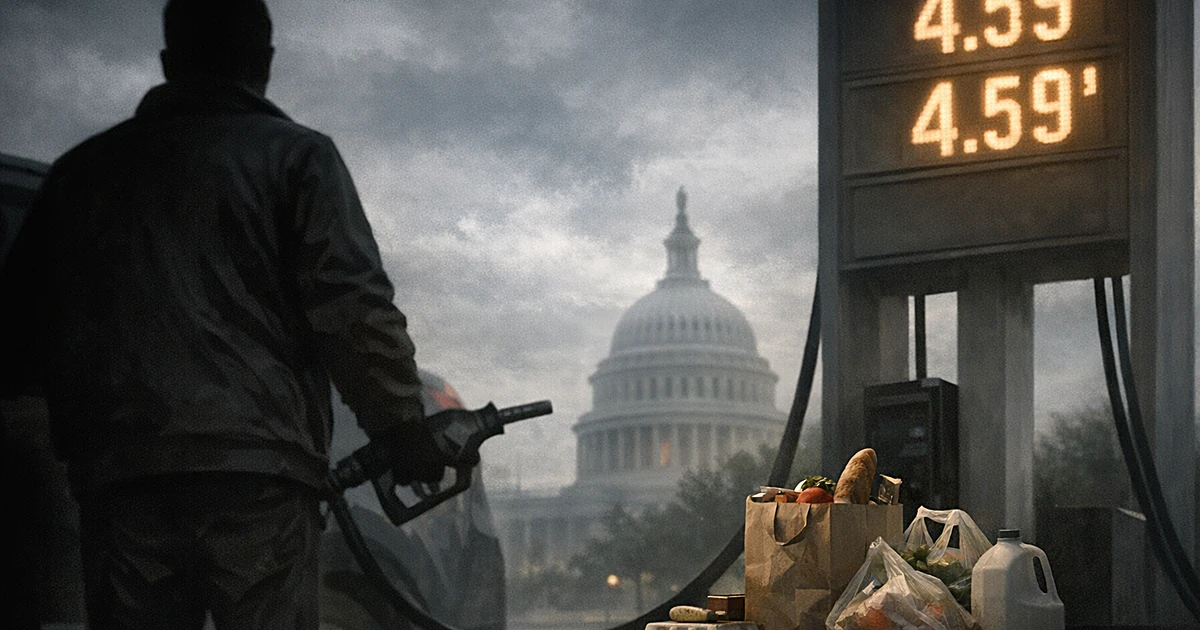
The exchange laid bare a tension that Republicans on Capitol Hill would rather not discuss: gas prices have spiked past $4.50 a gallon nationwide, inflation just hit a three-year high, and the party's legislative agenda has not yet delivered the relief voters were promised.
Johnson's Wednesday press conference came hours after the Labor Department released April figures showing inflation jumped to 3.8 percent, the highest rate in three years. The numbers landed on the same week that AAA data showed average gas prices topping $4.50 per gallon across the country, driven in part by Iran's blocking of oil tankers through the Strait of Hormuz.
What Trump actually said
The day before Johnson's presser, Trump told reporters that Americans' financial hardships were not motivating him "even a little bit" to cut a deal with Iran. He said he does not "think about Americans' financial situations", adding that his focus is on preventing Iran from obtaining a nuclear weapon.
The remark was direct, and it left Johnson in the position of explaining what the president meant. The Hill reported that Johnson moved quickly to soften the message, telling reporters he didn't know the full context of Trump's comment but could vouch for the president's concern about kitchen-table economics.
"I don't know the context in which he made that comment, but I can tell you the president thinks about Americans' financial situations. I talk to him, on average, twice a day, sometimes three or four times a day, and we talk about it constantly."
That framing, Trump cares deeply, even if his words suggested otherwise, became Johnson's throughline for the rest of the presser.
Johnson's case: blame Iran, credit the Big Beautiful Bill
The Speaker argued that Republicans have done the heavy lifting on inflation. He pointed to the party's legislative record and its centerpiece tax package.
"We've done everything, the Republican Party, under President Trump's leadership, have done everything that we possibly can to reverse the maddening inflation of the Biden years that was at 40-year highs, and all of the gross misspending of the last several years, to get the economy back humming again. And we've done that in the Big Beautiful Bill, the Working Families Tax Cut, infused with pro-growth policies."
Johnson then pivoted to Iran as the external obstacle. He said the administration is "laser-focused on trying to resolve the conflict in Iran," and that reopening the Strait of Hormuz would ease pressure on gas prices and the broader economy.
His prediction was optimistic. Johnson said he agrees with both the president and the Treasury Secretary that once the Iran situation is resolved, Americans will see "an alleviation of the pain at the pump" and prices will "come down overall."
That is a big promise tied to a geopolitical outcome that no one in Washington fully controls.
The affordability gap Republicans can't ignore
The numbers tell a story that no press conference can easily spin. Inflation at 3.8 percent in April is not the runaway crisis of 2022, but it is moving in the wrong direction. Gas above $4.50 a gallon hits working families hardest, especially in rural and suburban districts where driving is not optional. And the Biden-era spending that Johnson rightly criticizes did not create the Iran standoff now squeezing energy markets.
Johnson's argument that the Big Beautiful Bill and the Working Families Tax Cut represent the GOP's answer is fair as far as it goes. But legislation on paper and relief at the register are two different things. Voters who pulled the lever for Republicans in 2024 expected results they could feel, not explanations about why results haven't arrived yet.
The Speaker's challenge is compounded by the razor-thin House majority that makes every vote a negotiation and every defection a potential crisis. Moving big legislation through a chamber where a handful of absences can sink a bill requires discipline that the current conference has not always shown.
Johnson has navigated that tightrope before. He recently forced a House vote on full DHS funding rather than accept a Senate compromise, a move that showed he is willing to use procedural muscle when the stakes demand it. Whether he can apply that same leverage to deliver tangible cost relief is another question.
The political risk of candor
Trump's bluntness about his priorities, nuclear nonproliferation over pocketbook politics, was honest. Preventing a nuclear-armed Iran is a legitimate national security imperative, and no serious person would argue otherwise.
But honesty and political messaging are not always the same thing. When voters are paying $4.50 for a gallon of gas and watching grocery bills climb, telling them their financial pain is not on your radar, even momentarily, creates an opening that Democrats will exploit without hesitation.
Johnson understood that immediately. His response was a textbook cleanup: affirm the president's concern, redirect to the legislative record, and identify an external villain. Iran's blockade of the Strait of Hormuz is a real factor in energy prices, and blaming it is not dishonest. But it is incomplete.
The broader Republican agenda still needs to produce measurable results. The Working Families Tax Cut and the pro-growth policies Johnson cited have to translate into lower costs, not just talking points. The party has already seen members break ranks on high-profile votes, and affordability is the one issue where the base will not tolerate excuses indefinitely.
What comes next
Johnson's forecast, that resolving the Iran conflict will bring down prices, may prove correct. Energy markets respond quickly to geopolitical shifts, and reopening the Strait of Hormuz would increase global oil supply overnight. If the administration secures a deal or a de-escalation, the economic benefits could arrive fast enough to matter before the midterms.
But "as soon as that's resolved" is doing a lot of work in that sentence. Iran negotiations are notoriously unpredictable. And the internal dynamics of House Republican leadership mean Johnson cannot afford a prolonged period where the party's economic message amounts to "wait and see."
The Biden-era inflation that Johnson referenced, 40-year highs, gross misspending, gave Republicans their strongest argument in the last election cycle. Voters handed them power because they believed the GOP would fix it. The Iran conflict is a real obstacle. But obstacles are what leaders are elected to overcome.
Americans filling their tanks at $4.50 a gallon don't care about the Strait of Hormuz. They care about the number on the pump. Republicans promised to bring that number down. The clock is running.