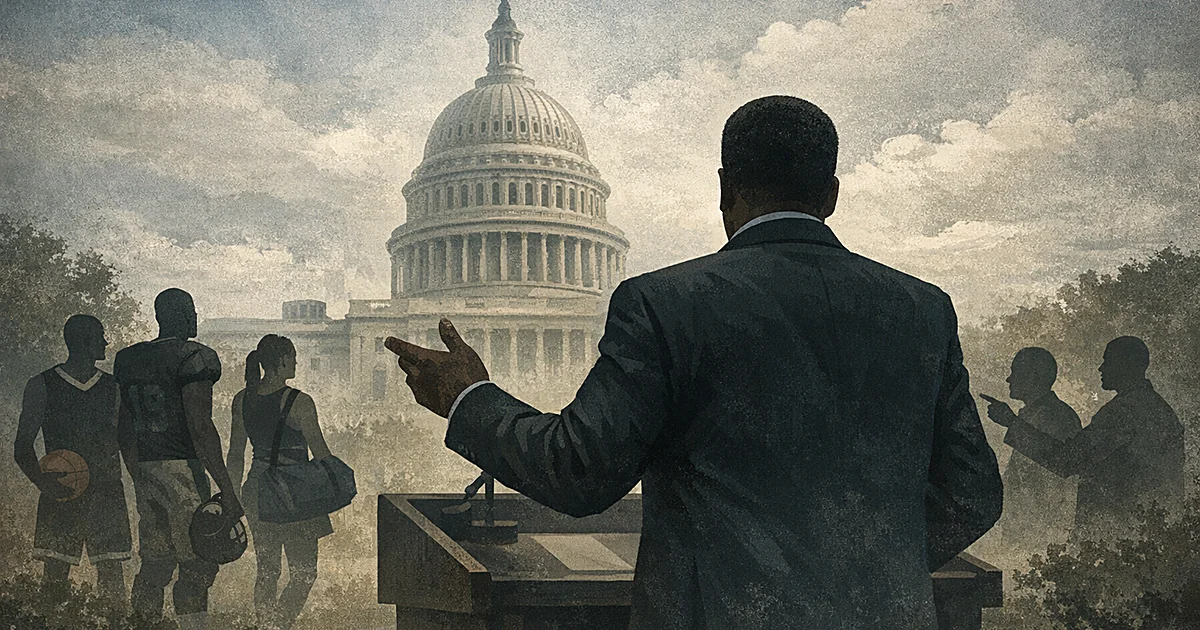
Craig Robinson rebuts civil-rights charge against college sports bill
Craig Robinson rejected claims that the Protect College Sports Act threatens civil rights, arguing the current transfer system can cost athletes an education.
Robinson, former President Barack Obama’s brother-in-law, traveled to Washington to support the college sports overhaul. He leads the National Association of Basketball Coaches.
Fox News Digital reported that the bipartisan bill had cleared two Senate hurdles. At that point, it was headed toward a final vote.
The NAACP, Congressional Black Caucus and Sen. Chris Murphy opposed the measure. They argued that its effects would fall hardest on Black student-athletes.
Robinson and other coaches dispute that charge. They say the legislation would protect compensation and transfers while restoring firm limits to a system they describe as unstable.
Robinson says repeated transfers can cost athletes a degree
Robinson said he “would disagree” with the civil-rights argument. He warned that athletes cannot get educated while “transferring to four or five different schools.”
That answer goes to the central dispute. Opponents focus on which athletes may face new restrictions. Robinson focuses on whether constant movement leaves those same athletes with a college education.
Craig Bohl, executive director of the American Football Coaches Association, also rejected claims of racist undertones. He called that argument “the farthest thing from the truth” and described it as “a misguided statement.”
Bohl said coaches want “opportunities for all.” His stated goals included player compensation, the ability to transfer and more stable eligibility rules.
He also drew a line against older athletes returning to college competition. Bohl said, “We don't need NFL players coming back playing in our game.”
Five-year eligibility and national NIL rules would replace uncertainty
The Protect College Sports Act would restrict transfers and create a five-year eligibility framework. It would also set rules against improper recruiting and tampering with athletes already enrolled elsewhere.
The bill would establish a federal standard for name, image and likeness compensation, commonly called NIL. It would also impose a cap on revenue sharing.
Those provisions seek one national set of rules for college athletics. The available description did not state the size of the revenue cap or detail every transfer restriction.
Sens. Ted Cruz and Maria Cantwell sponsored the bill, while Sen. Eric Schmitt served as a co-lead. Its bipartisan backing carried it through two Senate hurdles.
Schmitt said lawmakers were trying to address “the chaos that exists right now in college athletics.” He cited unlimited transfers, falling graduation rates and wide age gaps between players.
His example was blunt: 27-year-olds competing against 17-year-olds. Supporters argue that compensation can remain in place without allowing college eligibility to become open-ended.
Murphy and the NAACP cast the bill as a race issue
Murphy called the legislation “a civil rights issue.” He said the NAACP opposed it for the same reason and insisted, “I didn't make that up. That's the reality.”
The Connecticut senator argued that Black athletes would bear most of the bill’s effects. He said White coaches and college sports executives would receive most of its benefits.
The Congressional Black Caucus had opposed the legislation for months. It also tied that opposition to a Supreme Court decision involving the Voting Rights Act earlier that year.
But the record presented no specific data from Murphy, the NAACP or the caucus measuring the bill’s racial effects. Nor did supporters offer detailed figures disproving that claim.
That leaves a sharp policy divide rather than a settled factual finding. Critics see racial harm in new limits, while supporters see educational harm in unchecked transfers and unstable eligibility.
College athletes deserve compensation without permanent disorder
The coaches’ case does not rest on denying players money or mobility. Bohl expressly supported both, while also calling for rules that preserve eligibility and educational stability.
Robinson’s response matters because it challenges the claim on its own terms. If repeated transfers keep athletes from earning degrees, leaving the system untouched carries its own cost.
Lawmakers should judge the bill by its rules and results, not treat a civil-rights label as a substitute for evidence.