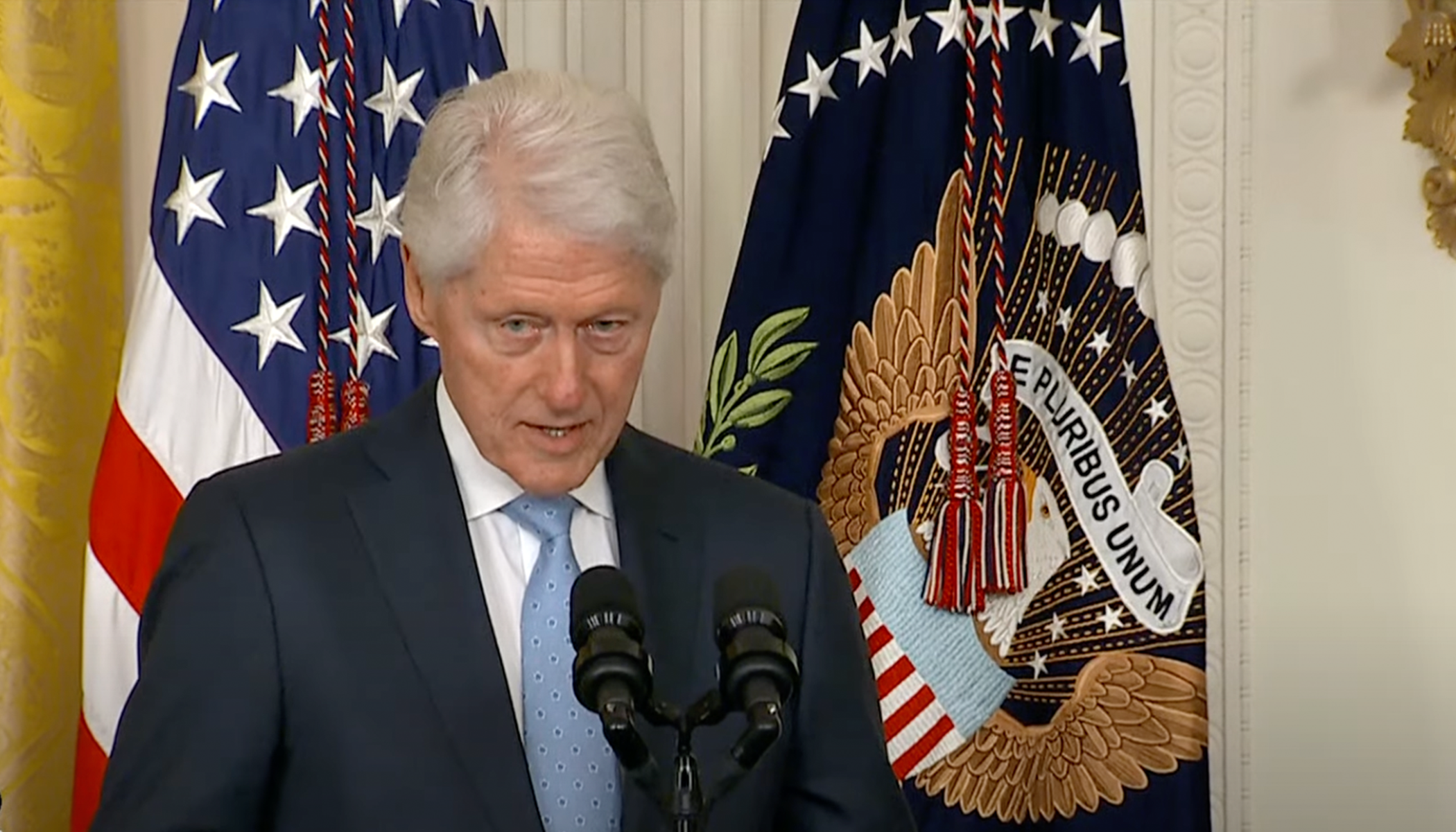
Body language expert says Bill Clinton showed 'cues of deception' during Epstein deposition
A behavioral expert who has trained alongside the FBI and CIA said Bill Clinton "appeared deceptive" during his closed-door deposition before the House Oversight Committee last week as part of the ongoing investigation into Jeffrey Epstein.
News Nation Now reported that Scott Rouse, the behavioral expert, told NewsNation's Jesse Weber that the former president exhibited clear warning signs when asked about his relationship with the billionaire sex offender. Rouse didn't mince words.
"He's showing all the things that protect himself from giving the true answer. I think he has what's called guilty knowledge of what happened."
Clinton was deposed Friday. His wife, Hillary Clinton, sat for her own deposition Thursday, during which she denied ever meeting Epstein. Both Clintons denied involvement in any criminal activity.
A friendship that keeps resurfacing
Bill Clinton has long maintained that he severed ties with Epstein before the financier's crimes came to light. The friendship reportedly ended in 2006 after criminal charges were brought against Epstein. A clean break, if you believe it.
The problem is the paper trail. Clinton's name and face appeared dozens of times in files released as part of the Justice Department's investigation into Epstein, including in flight logs and photos.
The latest release of those files confirmed a longstanding rumor about the existence of a painting depicting the former president posing in a blue dress and high heels, reportedly in Epstein's possession.
That's not the portfolio of a casual acquaintance.
What 'guilty knowledge' means
When NewsNation's Weber asked Rouse whether there were signs of deception by the Clintons, the expert zeroed in on the former president. He noted that Clinton was "tight in his mouth," a behavioral indicator that Rouse described as one of several "cues of deception."
"Him, definitely, but I'm not saying he did what they're saying. But he's showing all the things that protect himself from giving the true answer."
Rouse was careful to distinguish between deception and guilt for specific acts. But the concept of "guilty knowledge" is significant. It suggests that a person knows more than they are revealing, that they are actively managing what information escapes. It's the behavioral gap between what someone says and what someone knows.
For a former president whose connections to a convicted sex offender have generated scrutiny for years, the distinction between "I didn't do it" and "I'm not telling you everything I know" matters enormously.
The Clinton pattern
None of this will surprise anyone who watched the 1990s. Bill Clinton built a political career on his ability to parse language with surgical precision, to offer statements that were technically defensible while being substantively hollow.
"I did not have sexual relations with that woman" became a national punchline not because it was a lie in the narrowest legalistic sense, but because everyone understood it was designed to deceive.
Decades later, the technique appears unchanged. Deny everything. Claim the relationship was minor. Insist the break was clean. Meanwhile, the flight logs stack up, the photos circulate, and a painting that no normal friendship produces sits in the dead man's collection.
Hillary Clinton's claim that she never even met Epstein adds another layer. Given her husband's documented, extensive contact with the financier, the assertion strains credulity.
But it follows the same playbook: draw the circle of knowledge as small as possible and dare investigators to prove otherwise.
What the deposition can't hide
Closed-door depositions are designed to limit spectacle, but they can't eliminate scrutiny. The House Oversight Committee's investigation has produced a steady stream of revelations, and each new tranche of documents narrows the space available for carefully worded denials.
Body language analysis is not a courtroom verdict. Rouse himself acknowledged he wasn't accusing Clinton of the specific acts under investigation.
But behavioral expertise of this kind, developed alongside federal law enforcement agencies, carries weight precisely because it identifies what words are engineered to conceal.
Bill Clinton sat for a deposition about his relationship with a man who trafficked and abused young women on a massive scale.
A trained expert watched him do it and concluded he was hiding something. The former president's mouth was tight, his body protective, his answers guarded.
The words said one thing. Everything else said another.