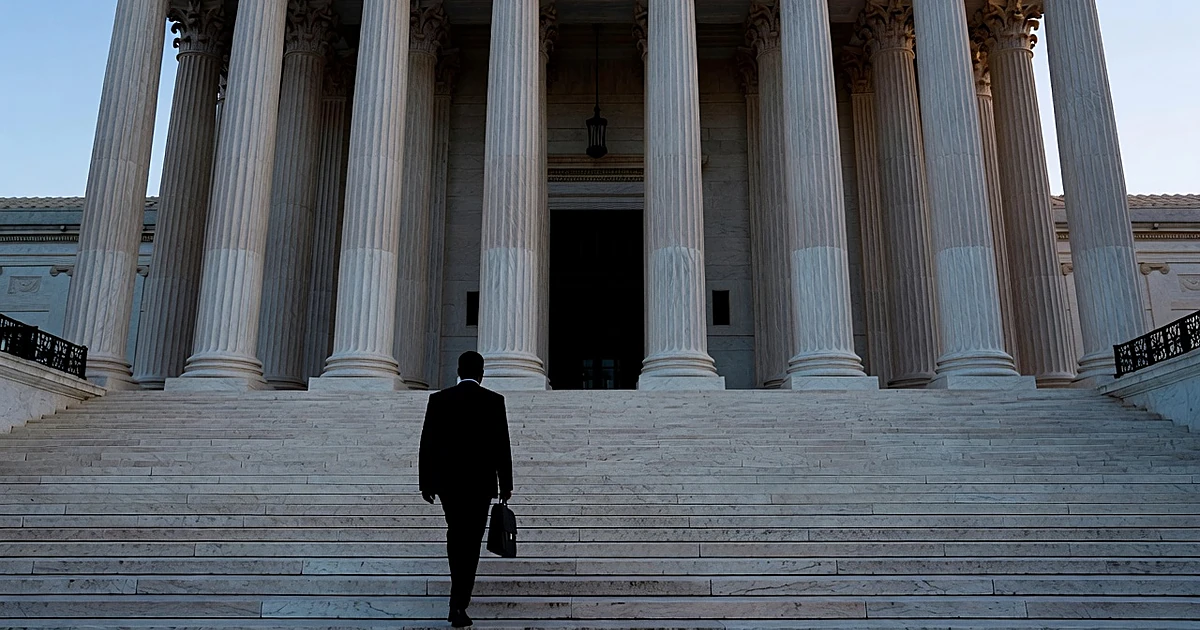
Supreme Court strikes down coordinated campaign spending limits in First Amendment ruling Democrats call an 'invitation for corruption'
The Supreme Court handed Republicans a major campaign finance victory Tuesday, striking down half-century-old federal limits on coordinated spending between political parties and their candidates in a 6-3 ruling that Democrats immediately condemned as a gateway to unlimited special-interest money in elections.
Justice Brett Kavanaugh led the conservative majority in finding that restrictions established in 1974 on coordinated campaign spending between party committees and candidates violated the First Amendment. The three liberal justices dissented. The decision means candidates and their party fundraising arms can now spend unlimited amounts in conjunction with one another, covering events, staff, travel, and advertising, with no cap.
The ruling ranks among the most consequential campaign finance decisions since Citizens United v. FEC in 2010, which opened the door to unlimited super PAC spending. But where Citizens United empowered outside groups, this decision empowers the parties themselves, a distinction that cuts in different directions depending on who's talking.
What the court said
Kavanaugh's opinion was direct. As Fox News reported, the majority wrote:
"In short, constitutional text, history, and precedent establish that the political-party coordinated-expenditure limits violate the First Amendment."
The case, National Republican Senatorial Committee v. FEC, originated from a 2022 lawsuit filed by the NRSC and NRCC, joined by then-Senator JD Vance and Steve Chabot's 2022 campaigns. The Republican committees argued that the Federal Election Campaign Act's caps on coordinated spending, which ranged from $130,600 to $4,071,800 for Senate candidates and up to $65,300 for most House candidates, as the Washington Examiner detailed, amounted to unconstitutional speech restrictions.
The FEC under the Trump administration dropped its defense of the law, leaving Democratic-aligned groups to carry the argument for keeping the limits in place. The Elias Law Group, a firm closely tied to Democratic legal strategy, defended the Democrats' appeal.
The ruling also overturned a 2001 precedent in which the Court had previously upheld these same coordinated spending limits, a fact the dissent seized on.
Democrats sound the alarm
Senate Minority Leader Chuck Schumer wasted no time framing the decision as a threat to democratic governance. In a statement, the New York Democrat said:
"Today's decision eviscerates one of the last fragile guardrails on coordinated political spending and will unleash a new arms race of campaign spending, bringing in even more special interest money to our elections."
Schumer characterized the ruling as giving wealthy donors and special-interest groups the green light to buy elections. His rhetoric fit a pattern. Schumer has made a habit of crying foul whenever institutional outcomes don't break his way, whether the subject is court rulings or federal indictments.
The DNC, DCCC, and DSCC issued a joint statement accusing the Court of acting to "eliminate a key safeguard against corruption in our elections." They called the decision a "clear and blatant effort to rewrite election rules for their own benefit and spend more money from billionaires to prop up their candidates."
DSCC Chairwoman Sen. Kirsten Gillibrand, DCCC Chairwoman Rep. Suzan DelBene, and DNC Chairman Ken Martin piled on. As Breitbart reported, their statement argued: "Republicans have failed the American people with a record that has ripped away health care and raised costs on families, and they know voters will hold them accountable in November, which is exactly why they are rewriting the rules."
Notice the pivot. Within hours, the Democratic response moved from a constitutional objection to a midterm campaign talking point. That tells you something about how seriously they take the legal argument versus how useful they find the political one.
Why Republicans see a First Amendment win
The chairmen of the House and Senate GOP campaign arms issued a joint statement saying the decision "restored core political speech and ensured parties can compete on a level playing field."
Sen. Bernie Moreno of Ohio, who is reportedly angling to become the next chairman of the Senate GOP campaign arm, put it more bluntly:
"A massive win for the First Amendment that gives power back to political parties over dark money Super PACs. Voters deserve to hear directly from candidates, not shady, nameless outside groups."
Moreno's framing highlights a point Democrats have largely ignored in their outrage: the ruling strengthens parties at the expense of the shadow ecosystem of super PACs and dark-money groups that have proliferated since Citizens United. For years, reformers on both sides complained that outside spending groups, accountable to no voter, had hijacked campaigns. This decision routes more money back through party committees, which are at least subject to disclosure requirements and voter accountability.
President Trump himself celebrated. "A BIG WIN FOR REPUBLICANS and, more importantly, The First Amendment!" he posted, as Newsmax reported.
The cash advantage that makes Democrats nervous
Strip away the constitutional rhetoric, and the Democratic panic becomes easier to understand in raw financial terms. The Republican National Committee holds more than $125 million in cash on hand. The DNC? Roughly $14.8 million, the New York Post reported, citing FEC filings.
That gap, nearly nine to one, means the ruling's immediate practical impact falls disproportionately in the GOP's favor. Former FEC Chairman Sean Cooksey told the Post: "Republicans have achieved a major victory with coordinated spending limits being struck down, and they are in the driver's seat because of their massive cash advantage."
Democrats know this. An unnamed Democratic campaign operative told the Washington Examiner that the party had been bracing for the decision. "No one's really p***ed since we've been anticipating for so long," the operative said, before outlining the tactical adjustments already underway.
"In terms of game plan, it's likely that party committees DCCC and DSCC will do more TV than they ever have before since they can get candidate rate and HMP/SMP will expand digital budget," the operative added.
But even that silver lining is disputed. Elias Law Group lawyers Jacquelyn Lopez and Rachel Jacobs pushed back on the idea that party committees would gain access to cheaper candidate-level advertising rates. Their statement noted: "Even the Trump Administration's own Solicitor General told the Supreme Court that broadcasters are required to offer those rates for candidate spending, not party spending, whether coordinated or independent."
The dissent's warning
Justice Elena Kagan, writing for the three liberal dissenters, warned that the majority was opening the door to donor influence that existing contribution limits were designed to prevent.
"The court ushers in untold harm by enabling parties to funnel large contributions to individual candidates, far in excess of what donors can give those candidates directly."
Kagan also wrote that the decision "rewrites the rules, to allow circumvention of the contribution limits." The dissent's core concern: if a donor can give a large sum to a party committee, and that committee can now spend it in unlimited coordination with a specific candidate, the individual contribution cap becomes a technicality.
It's a fair procedural concern. But it collides with a stubborn fact: the First Amendment doesn't come with a fundraising asterisk. The majority found that political speech, including coordinated party speech, is protected, full stop. Whether you like the consequences depends largely on whether you trust voters to sort through more speech or prefer regulators to decide how much is too much.
The Supreme Court's loaded June docket had already signaled that major decisions were coming. This one landed with force.
The broader political picture
For Schumer personally, the ruling arrives at a moment of declining influence. His hand-picked candidates have struggled in key primaries. An insurgent challenger surged past his preferred pick in the Maine Senate primary, and voices within his own party have begun openly questioning whether Democratic leadership has failed.
Sen. Elissa Slotkin told fellow Democrats that the party's leaders had failed and needed to move on. That kind of internal dissent doesn't emerge in a vacuum. It emerges when the people at the top keep losing, in elections, in courts, and in the argument over where the country is headed.
Now Schumer faces a campaign finance landscape that favors the opposition, a cash-strapped national committee, and a Supreme Court majority that has shown no interest in deferring to the regulatory framework Democrats spent decades building.
Speech or corruption?
The Democratic argument boils down to a single claim: more coordinated spending equals more corruption. The Republican argument boils down to a competing claim: restricting how parties and candidates communicate with voters is restricting speech, period.
What Democrats call a "safeguard," the Court's majority called a speech restriction that fails constitutional scrutiny. What Republicans call a restoration of political speech, Democrats call an invitation for billionaires to write bigger checks.
Both sides will now adapt. Democrats have already signaled they'll shift spending patterns through their committee and super PAC infrastructure. Republicans will press their cash advantage hard heading into the midterms.
But the constitutional question is settled, at least for now. The First Amendment protects coordinated party speech. The 1974 limits are gone. And the party that built the bigger war chest gets to spend it the way it wants.
Democrats spent years insisting that more regulation meant cleaner elections. The Court just told them that more speech means freer ones. Whether they like it or not, that's the law.