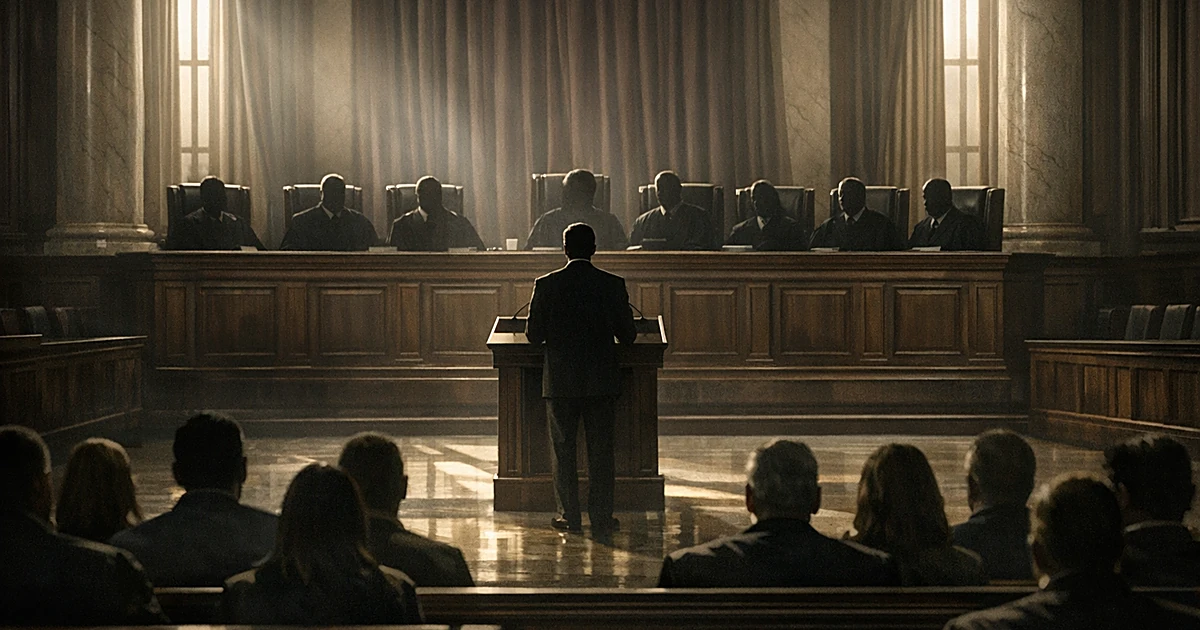
Justice Barrett presses Trump administration on birthright citizenship order's practical problems
Supreme Court Justice Amy Coney Barrett put Solicitor General D. John Sauer on the spot Wednesday, pressing him repeatedly on what she called the potentially "messy" consequences of President Trump's executive order restricting birthright citizenship, and she was not alone. Justices across the ideological spectrum challenged the administration's legal theory in oral arguments that, by multiple accounts, produced no clear ally for the government's position on the bench.
Trump himself sat in the courtroom for what The Hill described as the first known instance of a sitting president attending oral arguments before the Supreme Court. He watched as the justices he helped shape peppered his solicitor general with pointed questions about how the order would actually work in practice, and whether it could survive the 14th Amendment.
The executive order, signed on Day 1 of Trump's term, limits birthright citizenship to children born in the United States who have at least one parent with citizenship or permanent legal status. The administration's core argument rests on the phrase "subject to the jurisdiction thereof" in the 14th Amendment, contending it means children born to illegal immigrants should not automatically receive citizenship.
Barrett's 'foundlings' problem
Barrett zeroed in on the order's real-world application. She raised the old common-law concept of "foundlings", children of unknown parentage, and asked Sauer directly what the administration would do with them.
Sauer acknowledged "marginal cases" exist but pointed to Section 1401(f) of federal law, which grants citizenship to a child of unknown parentage found in the United States under the age of five, unless it is later shown before the child turns 21 that the child was not born in the country.
Barrett was not satisfied. She cut in with a line that drew attention for its bluntness:
"Yeah, yeah, yeah, yeah, but what about the Constitution?"
Her point was clear: a federal statute might address one narrow scenario, but the constitutional question remains. If the administration's reading of the 14th Amendment is correct, how does the government adjudicate citizenship at the moment of birth when it cannot know a parent's intent to remain in the country?
Barrett pressed further, laying out the practical tangle in specific terms:
"How would it work? How would you adjudicate these cases? You're not gonna know at the time of birth, for some people, whether they have the intent to stay or not."
She then offered a hypothetical that extended the problem beyond illegal immigration entirely. What about a U.S. citizen living in Norway with her husband and family, who comes home, has a child, and returns? Under the administration's logic, how would anyone determine whether the child qualifies for citizenship if the standard involves the parent's intent to stay?
"Including U.S. citizens, by the way," Barrett added, a remark that underscored how the administration's framework could reach far beyond its stated targets.
Sauer's defense: 'Objectively verifiable'
Sauer pushed back, drawing a distinction between the hypotheticals Barrett raised and the executive order's actual mechanics. He argued the order relies on "objectively verifiable things", specifically, immigration status, rather than subjective judgments about intent.
"The practical point is under the terms of this executive order, you don't have to, because the executive order turns on objectively verifiable things, which is immigration status. Are you lawfully present, but temporarily present, or do you have an illegal status? So taking evidence, so to speak, under subjective attempt wouldn't be done."
He also pointed to federal guidance the administration issued, which he said "provides, I think, very, very clear objective, verifiable approaches" to carrying out the order. But whether the justices found that reassurance persuasive remained an open question throughout the session.
The administration's challenge extends beyond Barrett. As we previously reported, Trump's birthright citizenship challenge has met skepticism from justices on multiple fronts.
Roberts and the 'big group' problem
Chief Justice John Roberts posed his own pointed challenge to the administration's reasoning. The government has long acknowledged narrow exceptions to birthright citizenship, children of foreign diplomats and children born during hostile enemy occupation, for instance. Roberts questioned how those tiny carve-outs could justify the sweeping exclusion the administration now seeks.
"I'm not quite sure how you can get to that big group from such tiny and sort of idiosyncratic examples."
That skepticism from the chief justice matters. Roberts has historically been protective of the Court's institutional standing and wary of dramatic departures from long-settled precedent. His framing suggested he sees a significant gap between the administration's legal foundation and its desired outcome.
The Washington Examiner reported that Justice Clarence Thomas, often viewed as a reliable conservative vote, also pressed the administration with sharp questions about whether the 14th Amendment's history actually focused on immigration concerns. Justice Elena Kagan said the solicitor general was relying on "pretty obscure sources" to support an interpretation that would change more than a century of understanding.
No clear ally on the bench
National Review's Dan McLaughlin wrote that "it was expected to be hard sledding for Solicitor General D. John Sauer, and it was." McLaughlin's assessment was blunt: "There wasn't anyone unambiguously taking Sauer's side."
That observation tracks with what multiple outlets reported from the courtroom. Justice Ketanji Brown Jackson told Sauer directly, "I think you have a number of hurdles," as the Washington Times noted. The administration has already lost in every lower court that has considered the case, and the executive order remains on hold while the Supreme Court weighs in.
This is not the first time the Court has pushed back on Trump administration actions this term. The justices have handed the administration setbacks on other fronts as well, reflecting a broader pattern of judicial scrutiny.
Barrett as the administration's biggest concern
Barrett's questioning drew particular attention because of her status as a Trump appointee. Fox News reported that George Washington University law professor Jonathan Turley identified her as "probably the greatest concern right now for the Trump administration." Barrett also pressed Sauer on whether the administration would follow lower-court precedent, challenging his repeated use of the word "generally" when describing executive compliance with circuit court rulings.
"I want to ask you about a potential tension, well, no, not a potential tension, an actual tension," Barrett said during arguments, signaling that her concerns went beyond the birthright citizenship question to the administration's broader posture toward the courts.
Fox News noted Barrett has already drawn criticism from some Trump allies after siding against the administration in a separate ruling related to USAID. Her trajectory this term has made her a figure to watch on cases where executive authority meets constitutional limits.
The Court's emergency docket has surged this term, and the birthright citizenship case adds another high-stakes question to an already crowded calendar.
The constitutional stakes
What makes this case different from ordinary policy disputes is the weight of what the administration is asking the Court to do. The 14th Amendment's citizenship clause has been read for more than a century to guarantee birthright citizenship to virtually everyone born on American soil. The Supreme Court's 1898 decision in Wong Kim Ark established that precedent in terms the legal world has treated as settled.
The Trump administration is asking the justices to read the phrase "subject to the jurisdiction thereof" far more narrowly than courts have read it for generations. If the Court agrees, it would represent one of the most consequential shifts in constitutional interpretation in modern history. If it does not, the executive order stays blocked, and the question of birthright citizenship remains where it has been since the Reconstruction era.
The administration deserves credit for bringing a serious constitutional argument to the highest court in the land rather than governing by fiat. Executive orders that test legal boundaries are not inherently improper, they are how presidents push the law to evolve. But the oral arguments made plain that the justices, including those appointed by Trump, see significant obstacles in the administration's path.
Trump's interest in shaping the Supreme Court's ideological direction has been a defining feature of his presidency. Yet the bench he helped build is showing that independent judicial judgment does not come with a loyalty card, which is, in the end, exactly how the system is supposed to work.
The real question is whether the administration can thread a constitutional needle that, after Wednesday, looks narrower than ever. Barrett's hypotheticals were not academic exercises. They were a preview of the practical chaos that could follow if the Court rewrites a rule Americans have lived under since the 19th century, and a signal that at least some conservative justices want answers before they sign on.
When even the justices you appointed start asking "but what about the Constitution?", it is worth listening.