New Jersey governor reverses course on ICE blockade after Mullin pressure, state police clear Delaney Hall
New Jersey State Police cleared protesters blockading ICE's Delaney Hall detention center in Newark on Friday night after Democratic Governor Mikie Sherrill reversed her refusal to cooperate with federal immigration enforcement, a capitulation that came only after Homeland Security Secretary Markwayne Mullin reminded her he could shut down international travel at nearby Newark airport.
The standoff had lasted days. Sherrill had refused to let state troopers assist ICE officers at the facility, which can hold up to 1,000 illegal immigrants. Mullin applied direct pressure, warning the governor that he could reassign customs officers from Newark's airport to guard Delaney Hall, a move that would have choked one of the busiest international terminals on the East Coast.
By Friday evening, Sherrill folded. By midnight, the blockade was gone, debris had been hauled away, and some protesters were under arrest. The sequence offers a clean case study in what happens when the federal government stops asking and starts leveraging.
Sherrill's retreat and the language used to disguise it
The governor's public statement tried to frame her reversal as a proactive decision rather than a concession. Breitbart reported that Sherrill posted on social media:
"I will not give ICE the pretext to expand operations in our state. For that reason, New Jersey law enforcement is today establishing a peaceful, protected, protest zone in the area outside Delaney Hall. My Administration will be working together with community members, faith leaders, advocates, and State Police to help people move there today. Our top priority is public safety, and we need to take this opportunity to lower the temperature now."
Read that again. The governor who spent days refusing to send troopers now cast herself as the one lowering the temperature. She dressed up a retreat as a safety initiative, complete with talk of "community members" and "faith leaders." The blockade was the temperature. Her inaction was what kept it elevated.
Mullin saw it differently. The DHS secretary posted on X:
"This is a win for law and order. After days of @GovSherrillNJ REFUSING to allow State Police to assist @ICEgov law enforcement against violent anti-ICE rioters, she is now allowing the New Jersey State Police to cooperate with us. Thank you, Governor."
The "thank you" landed like a period at the end of a sentence Sherrill did not want written.
How the blockade ended
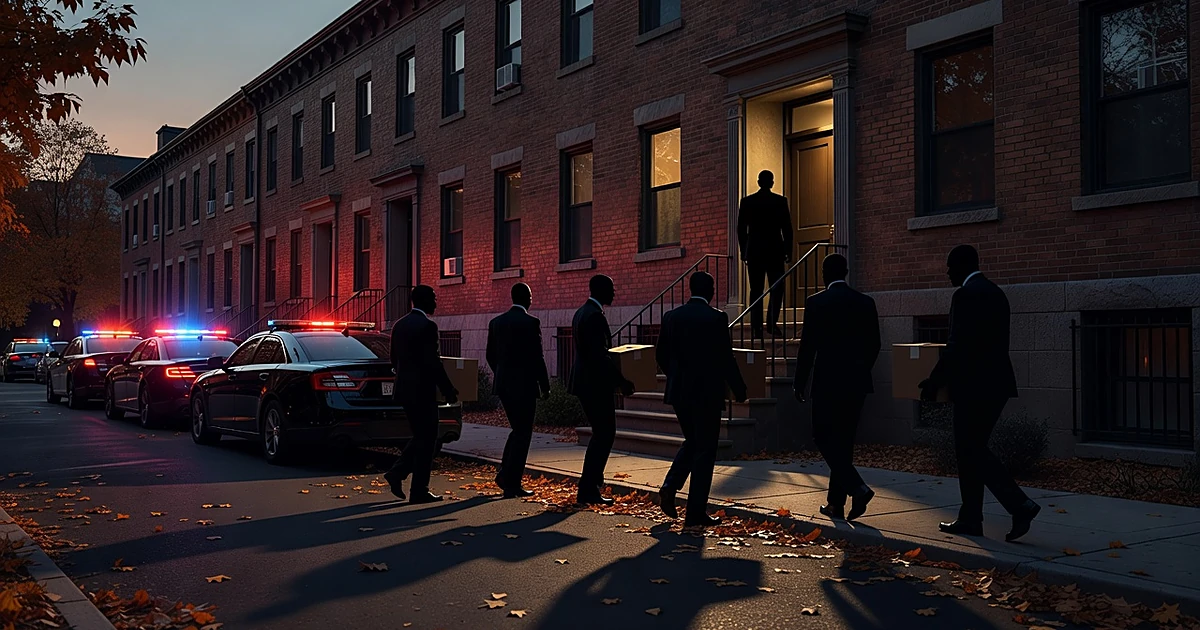
State police and ICE officers moved in Friday night. They removed protesters from the area outside Delaney Hall and cleared debris left behind by what the reporting described as a well-supplied protest camp. Some of the protesters were arrested and now face jail time, though specific charges, arrest counts, and identities have not been disclosed.
New Jersey Attorney General Jennifer Davenport issued a midnight statement that tried to soften the optics. She said state police "temporarily cleared the area outside Delaney Hall" and described the protesters as "overwhelmingly peaceful." That characterization sits uneasily alongside the fact that state troopers had to physically remove them and that arrests followed.
Mullin, confirmed by the Senate earlier this year to lead DHS, has shown a willingness to use the federal government's operational leverage in ways his predecessor did not. The Newark airport threat was not subtle. It was not a press release. It was a direct reminder that the federal government controls the customs officers who keep international flights moving, and that a governor who obstructs federal law enforcement may find other federal services suddenly in short supply.
The protest camp and who was behind it
The reporting described the protest encampment as well-funded and well-supplied, though it did not identify specific funding sources or provide crowd-size estimates. Social media posts referenced in the coverage showed police pushing protesters away from the facility perimeter.
Mullin characterized the demonstrators as "violent anti-ICE rioters." The attorney general called them "overwhelmingly peaceful." No detailed accounting of violent acts, injuries, or property damage appeared in the available reporting, leaving a gap between the two characterizations that neither side has filled with specifics.
What is clear is that the blockade physically prevented federal officers from operating freely at a detention facility holding up to 1,000 illegal immigrants. Whatever label one attaches to the protesters, the effect of their actions was obstruction of federal immigration enforcement, and a Democratic governor initially let it happen.
The transition at DHS leadership that brought Mullin into the role appears to have produced a more confrontational posture toward state-level resistance. Where previous approaches relied on public statements and legal filings, Mullin reached for the most concrete tool available: the threat of operational disruption at a major airport.
The governor's contradiction
Sherrill's stated rationale deserves scrutiny. She said she would "not give ICE the pretext to expand operations in our state." But ICE was not expanding operations. It was trying to operate a detention facility it already controlled. The blockade was the expansion, an expansion of protest into physical obstruction of federal law enforcement.
By framing her reversal as a move to deny ICE a "pretext," Sherrill implied that the real threat was federal overreach, not the mob outside Delaney Hall. That framing collapses under the weight of the timeline. For days, she refused to act. Mullin applied pressure. She acted. The blockade ended. The sequence is not complicated.
The DHS account posted late Friday night: "America is safer when state & federal law enforcement work together." The statement was bland by design. It did not need to be sharp. The outcome spoke for itself.
There is no indication that Mullin offered Sherrill any concessions in exchange for her cooperation, no reduction in deportation operations, no scaling back of the facility's capacity, no public assurances about limiting ICE activity in New Jersey. If the governor extracted anything in return, neither side has said so.
A broader pattern
The Newark standoff fits a pattern that has repeated across blue states and cities since the current administration began enforcing immigration law more aggressively. Local Democratic officials resist. The federal government applies pressure, sometimes through courts, sometimes through funding threats, sometimes through operational leverage. The local officials eventually comply, then issue statements insisting they did so on their own terms.
The Justice Department's recent moves on citizenship revocation reflect the same posture: the federal government is willing to use every available tool, and it is not waiting for state-level cooperation to arrive voluntarily.
Sherrill's position was always untenable. A governor cannot indefinitely refuse to maintain order outside a federal facility and expect no consequences. The Newark airport threat made the cost concrete and immediate. International travelers delayed, flights disrupted, economic damage to one of the state's busiest transportation hubs, that is not a political abstraction. That is the kind of pressure that moves politicians who have stopped listening to arguments about the rule of law.
The upheaval that preceded Mullin's arrival at DHS left the department in need of a leader willing to act decisively. Whatever one thinks of the former secretary's tenure, the contrast in approach at Delaney Hall is visible. Mullin did not issue a statement and wait. He identified leverage, applied it, and got results inside a week.
What remains unanswered
Several questions remain open. How many protesters were arrested, and what charges do they face? How long had the blockade been in place before Sherrill acted? Who funded and supplied the protest camp? And does Sherrill's reference to a "peaceful, protected, protest zone" mean some form of organized demonstration continues near the facility, or was the entire encampment dismantled?
None of these questions have been answered publicly. The attorney general's midnight statement was carefully vague. The governor's post read like it was drafted by a committee of political consultants trying to make a surrender look like strategy.
The people who live and work in Newark, the taxpayers, the commuters, the residents who had to watch a mob blockade a federal facility while their governor did nothing, did not get a statement explaining why it took days of federal pressure to produce basic law enforcement.
When a governor has to be threatened with airport shutdowns before she will clear a blockade outside a federal building, the problem is not the federal government's tactics. The problem is a political class that treats obstruction of immigration enforcement as a constituency service and public order as an afterthought.