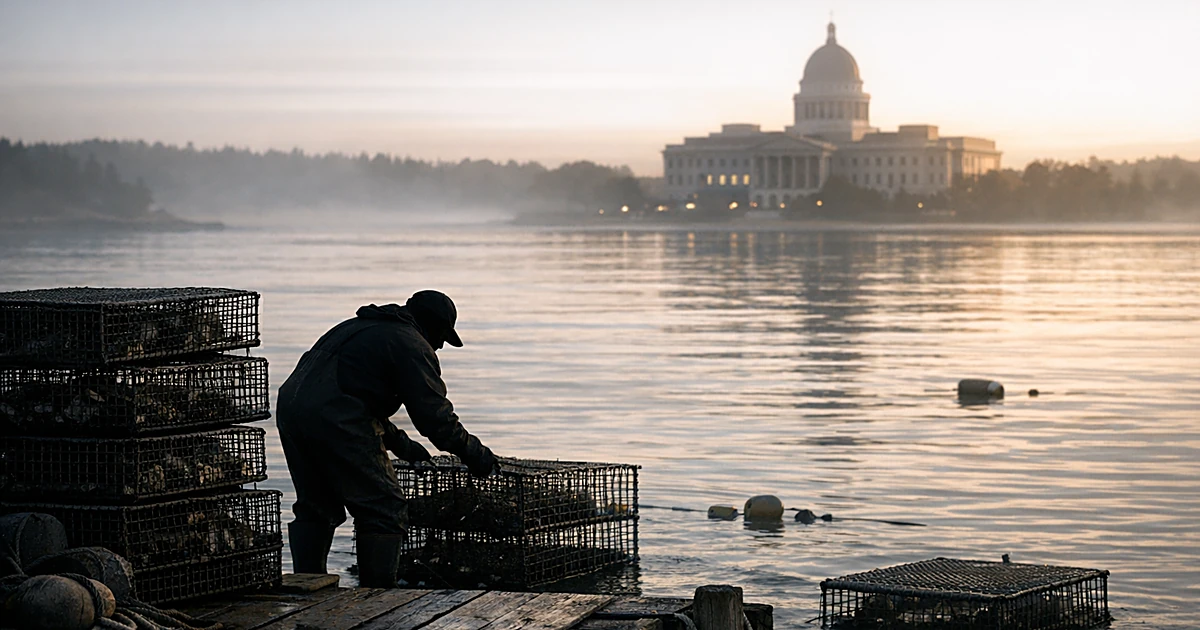
Oyster farmer's surge in Maine Senate primary threatens Schumer's hand-picked candidate
Two months before Maine's June Democratic Senate primary, Chuck Schumer's recruited candidate is losing, badly. Governor Janet Mills trails challenger Graham Platner by 27 points in the latest Emerson survey, a gap that has widened even as the party establishment pours resources into propping her up. The race is shaping up as the most visible crack yet in Schumer's strategy for retaking the Senate.
Platner, an oyster farmer and military veteran with no prior political office, has outpaced Mills in both polling and fundraising. He raised $7.8 million throughout 2025. Mills raised $2.7 million over the same period, though she reported another $2.6 million in the first quarter of 2026. Platner has not yet released his latest figures.
The dynamic amounts to a full-blown headache for national Democrats. Schumer built his 2026 Senate map around recruiting "tested" candidates, sitting or former governors, ex-senators, former House members, in the GOP-held seats Democrats need to flip. Mills, a two-term governor, fit that mold. Platner does not.
Schumer's recruitment strategy meets grassroots resistance
Maine is one of four Republican-held Senate seats Democrats must flip to have any shot at the majority. Schumer's broader recruitment effort included Roy Cooper in North Carolina, Sherrod Brown in Ohio, and Mary Peltola in Alaska, all names with statewide profiles and electoral track records. The theory was simple: big names win swing states.
In Maine, that theory is collapsing. Platner's polling lead has reached as high as 33 points in recent surveys. He has saturated the airwaves with biographical ads while Mills struggled to gain traction. The Washington Examiner reported that Platner's campaign put out a memo last week telling donors and supporters the team feels "emboldened" by its lead and plans to pivot toward attacking Susan Collins in the closing weeks of the primary, a general-election posture that signals confidence the nomination fight is all but over.
The pattern is not unique to Maine. Schumer's preferred candidates have faced growing questions about his leadership and his ability to steer outcomes within his own party. In Iowa, the Democratic Senatorial Campaign Committee hosted an event for state representative Josh Turek in February, but progressives are backing state senator Zach Wahls instead. In Michigan, Rep. Haley Stevens, widely viewed as Schumer's pick to replace retiring Sen. Gary Peters, has struggled to break away from the competition in polling.
When a party leader's hand-picked recruits keep stumbling, the problem is not the candidates. It is the leader.
Platner's baggage, and why it matters for the general election
Platner is not without vulnerabilities, and they are significant. He spent the early part of his campaign apologizing for offensive Reddit posts made roughly a decade ago. Mills's ads highlighted posts that the campaign characterized as blaming rape victims, dating to around 2013. The New York Post reported that one online post praised urinating on dead Taliban fighters as a display of "dominance."
Platner also faced scrutiny over a tattoo he said he got in Croatia after a night of drinking while on leave. He claimed he did not know about the tattoo's association with Nazi paramilitary police. He blamed the posts and other controversies on a period of disillusionment after returning from tours in Iraq and Afghanistan.
These are not minor issues. And they are precisely the kind of liabilities that a general-election opponent can exploit. Collins's spokesman, Shawn Roderick, told reporters the senator:
"will be prepared to run a substantive, issues-oriented campaign regardless of who the opponent is."
Collins has previously signaled she would relitigate Platner's controversies if he wins the nomination. The Republican incumbent won a fifth term comfortably in 2020, even after surveys showed her trailing by as much as 12 points. She entered 2026 with a larger war chest than both Democratic competitors. And the Senate Leadership Fund is planning to spend at least $42 million in Maine backing Collins, part of a more than $300 million commitment for fall advertising.
In other words, Republicans are ready. The question is whether Democrats are nominating the candidate best positioned to survive what is coming, or the one who makes progressives feel good in April.
Mills fights back, but the math is daunting
Mills has not conceded anything. In recent days she swatted away the notion that the primary is over or that she is dropping out. On Tuesday she released a detailed, 19-page policy platform and reiterated her commitment to five debates with Platner in May. She has promised to serve a single term if elected and swore off corporate PAC money, framing her campaign around a willingness to "stand up" to President Donald Trump.
Her campaign spokesman, Tommy Garcia, told the Portland Press Herald:
"As the only Democrat elected statewide in Maine in the past 20 years, Janet Mills knows how to win tough battles and deliver results, and that's why she's the best candidate to beat Susan Collins in November and is running full steam ahead to defeat her."
That line, "the only Democrat elected statewide in Maine in the past 20 years", is the core of the electability argument. And it is exactly the argument that primary voters appear to be rejecting. Mills went negative about a month ago, releasing a pair of commercials attacking Platner. The attacks have not closed the gap.
Meanwhile, Platner has called on Schumer to step down as minority leader and aligned himself with progressive senators, a posture designed to make the contest a referendum on Washington itself. In a state of 1.4 million people, that populist message is resonating in a way the establishment candidacy is not.
A wider pattern of Democratic division
Maine is not an isolated case. Across the Senate map, Schumer's party is fracturing between its institutional wing and its progressive base. The DSCC has helped Mills fundraise, but the committee's influence has not translated into voter support. The Iowa and Michigan primaries show similar tensions. National Democrats keep picking one horse; primary voters keep eyeing another.
This is the same party whose members have broken publicly with leadership on foreign policy and whose senior figures have admitted failure on border security. The fractures are not cosmetic. They reflect a genuine disagreement about what the party stands for, who should lead it, and whether the old playbook still works.
For Republicans, the Maine dynamic is a gift. If Platner wins the nomination carrying a decade's worth of inflammatory online posts, a tattoo controversy, and a thin political résumé, Collins will have a target-rich environment. The $42 million the Senate Leadership Fund plans to spend will go a long way in a small state.
On the other hand, if Mills somehow claws back and wins the primary, she will emerge battered, outspent in the primary, and facing a well-funded incumbent who has already proven she can defy the polls. Neither outcome is what Schumer drew up on the whiteboard.
The broader lesson extends beyond Maine. Schumer's theory, that recruiting familiar, establishment-friendly names would smooth the path to a Senate majority, assumed Democratic primary voters would follow the plan. They are not following it. In state after state, the base is drifting toward candidates the national party did not choose and, in some cases, does not want. The ongoing congressional leadership battles only underscore how little control any party leader has over his own conference right now.
For Collins, the playbook is straightforward: run on her record, keep her war chest full, and let Democrats sort out their own mess. For Schumer, the playbook is in tatters.
When your hand-picked governor trails an oyster farmer by double digits in your must-win state, the problem is not the voters. It is the plan.