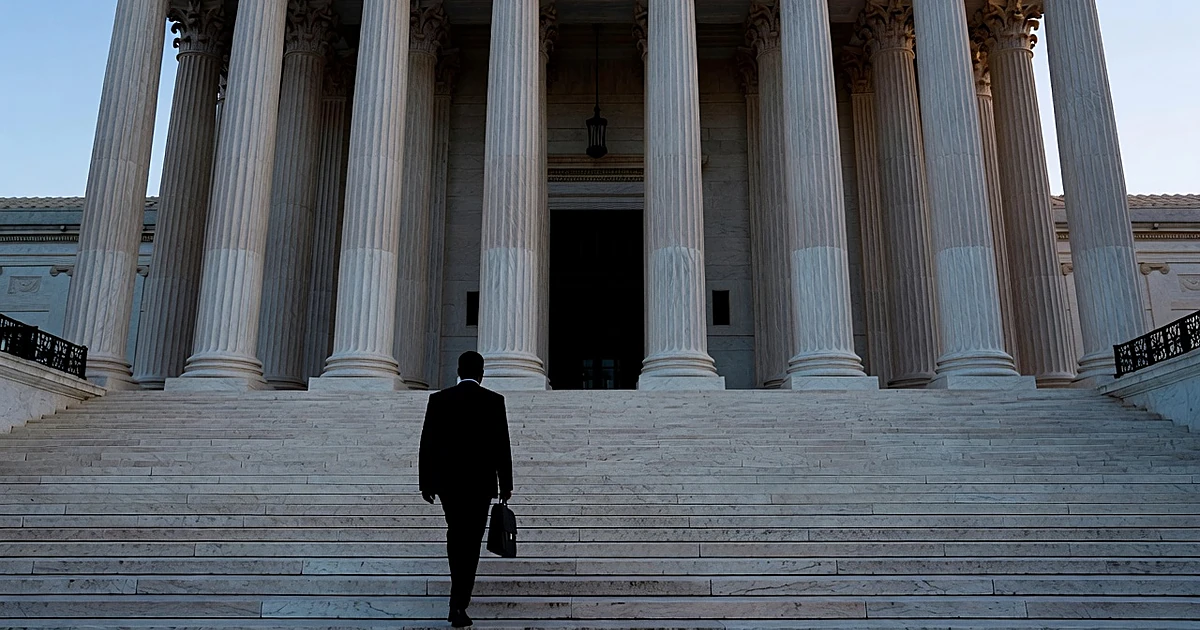
Supreme Court set to review Trump's bid to remove Fed governor from post
Could the Federal Reserve, the bedrock of America’s economic stability, be under threat from political overreach?
The U.S. Supreme Court is set to hear arguments on Wednesday regarding President Donald Trump’s attempt to fire Federal Reserve Governor Lisa Cook, an appointee of former President Joe Biden and the first Black woman to serve in that role. This case, unfolding four months into Trump’s second term, follows Cook’s lawsuit in August after Trump sought to remove her, citing allegations of mortgage fraud which she has denied. The legal battle also comes amid broader scrutiny, including a criminal investigation into Fed chair Jerome Powell by Trump’s Justice Department over congressional testimony.
The Supreme Court, with its 6-3 conservative majority, previously allowed Cook to remain in her post while the case proceeds, signaling potential interest in safeguarding the Fed’s independence under the Federal Reserve Act of 1913, which limits presidential removal of governors to specific “cause.” This is the second major economic policy case of the Court’s current term, which began in October, following arguments in November over Trump’s global tariffs where justices expressed skepticism about their legality. Rulings on both cases are expected by the end of June, though they could arrive sooner.
Debating the Limits of Presidential Power
The issue has sparked intense debate over how much control a president should wield over the nation’s central bank. Critics of Trump’s actions suggest this is a push to pressure the Fed into lowering interest rates ahead of the November midterm elections, where Democrats aim to reclaim Congress. Supporters, however, argue that accountability to elected officials is vital for economic stewardship, as Newsmax explains.
Look at the historical context: legal scholars note the Supreme Court hasn’t been this entangled in economic policy since Franklin Roosevelt’s New Deal battles during the Great Depression. The Fed’s independence, enshrined for over a century, is seen as a bulwark against inflation driven by political whims. Tampering with that could unsettle markets and erode public trust.
Trump’s claim of mortgage fraud against Cook, which she calls a pretext for policy disagreements, was deemed likely insufficient by a Washington-based federal judge. A federal appeals court upheld that ruling, prompting Trump to seek Supreme Court intervention. This isn’t just about one governor; it’s about whether the Oval Office can bend the Fed to its will.
Fed Independence Hangs in the Balance
Legal analyst John Yoo warns, “I think they worry about the effect that removal of central bank independence could have on the economy.” That’s an understatement when you consider how political meddling in monetary policy could spiral into runaway inflation. History, from Weimar Germany to modern Venezuela, backs this caution.
Then there’s the parallel probe into Fed chair Jerome Powell, which critics see as another lever to influence interest rates. Powell himself called it a pretext on Sunday, tied to his testimony about a Fed building project. This dual-front approach raises eyebrows about the administration’s true aims.
Legal expert Kathryn Judge adds, “This Supreme Court has taken a very expansive approach to executive authority, but it is not unbounded.” Her point cuts to the core: even a Court often deferential to Trump in emergency rulings—on immigration, federal layoffs, and more—might draw a line at economic overreach. The justices seem wary of handing unchecked power over the money supply.
Contrasting Rulings and Past Precedents
Consider last May’s ruling in Trump v. Wilcox, where the Court permitted Trump to remove two Democrat labor board members while challenges lingered in lower courts. Yet, in an unsigned opinion, the justices emphasized the Fed’s unique, quasi-private structure, distinct from other agencies. That distinction could be pivotal here.
Unlike those labor board cases, or even Trump’s wins on foreign aid cuts and military policy, this dispute directly impacts economic levers. The Court has historically leaned toward Trump in emergency rulings over the past 12 months, but analysts sense less enthusiasm for expanding his grip on fiscal matters. It’s a nuanced tightrope.
The justices’ decision to keep Cook in place while her case unfolds—unlike their stance with other agency officials—hints at a protective instinct for the Fed. Legal analysts see this as a clue to their priorities. It’s not just about one person; it’s about preserving a system that’s worked for decades.
Broader Implications for Economic Policy
This case, alongside the tariff dispute, could redefine presidential influence over the economy. If Trump prevails, it might embolden future administrations to treat the Fed as a political tool, undermining its credibility. That’s a risk even market-friendly conservatives should ponder.
On the flip side, a ruling for Cook could reinforce the Fed’s autonomy, ensuring monetary decisions aren’t swayed by electoral cycles. It’s not about denying presidential oversight but balancing it against the need for steady, independent policy-making. The stakes couldn’t be higher as June approaches.
Ultimately, the Supreme Court’s verdict will resonate far beyond Washington’s marble halls. It’s about whether America’s economic foundation remains insulated from partisan storms. As the justices deliberate, the nation watches, knowing the outcome could shape prosperity for years to come.