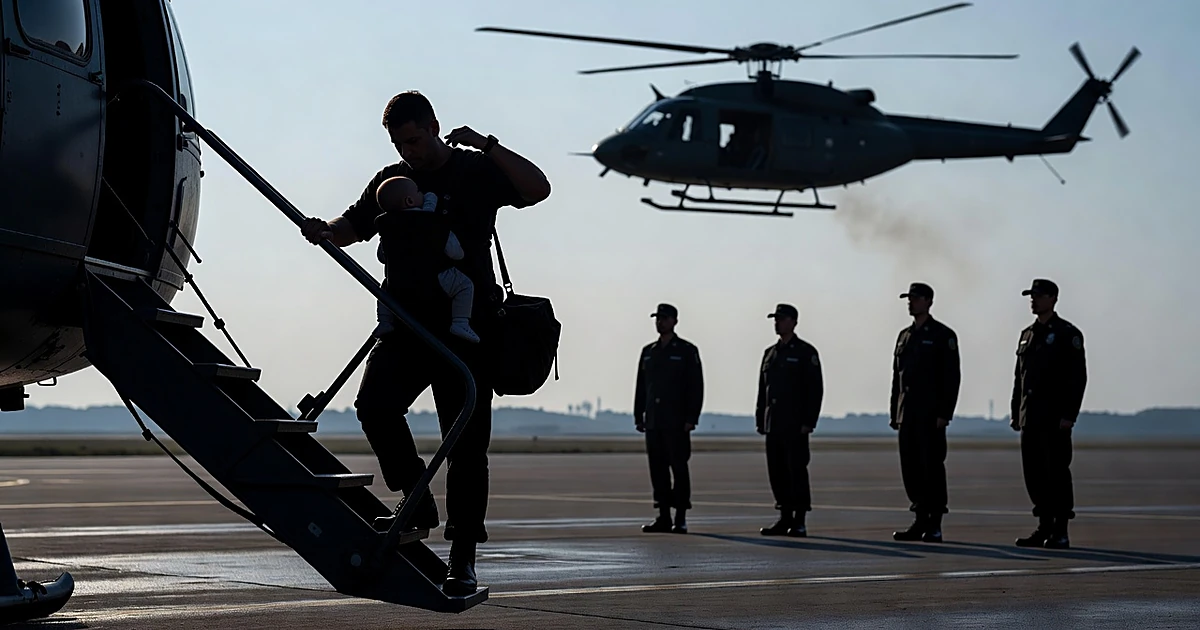
Trump vows retaliation after six service members killed and drones strike US embassy in Riyadh
Six American service members are dead in Iran, the US embassy in Riyadh was attacked by drone fire on Monday, and President Trump has promised a response is coming soon.
The embassy in Saudi Arabia's capital was struck by two unmanned aerial vehicles that hit the roof and the perimeter of the consulate, according to the State Department. Eight additional drones were intercepted near the cities of Riyadh and Al-Kharj. No injuries were reported at the embassy, and staff sheltered in place. But by early Tuesday morning, witnesses described explosions and smoke rising over Riyadh's diplomatic quarter, with multiple sources reporting a fire broke out at the compound after a blast.
The strikes came just days after Trump authorized preemptive military action against Tehran, a decision now validated by the very attacks it sought to prevent.
Trump: "You're going to find out soon"
In a Monday night interview with News Nation, the president left little ambiguity about what comes next. Asked about retaliation for the deaths of six soldiers and the embassy attack, Trump was direct:
We're doing a lot of damage. We're inflicting tremendous damage on them.
He called the campaign "ahead of schedule" and said he did not believe boots on the ground were necessary. When pressed on what the American response would look like, he offered four words: "you're going to find out soon."
Trump also dismissed concerns about attacks on American soil or US bases, framing the casualties in characteristically plain terms:
No, it's a part of war. It's part of war, whether people like it or not, that's the way it is.
That kind of candor will unsettle the commentariat, the Daily Mail reported. It shouldn't. A commander-in-chief who acknowledges the cost of war without flinching from its prosecution is not being callous. He's being honest about what conflict demands.
Rubio reveals the intelligence behind the preemptive strikes
Secretary of State Marco Rubio filled in the strategic picture on Capitol Hill, briefing a small group of congressional leaders on the joint US-Israel offensive against Iran. His explanation for why the administration struck first was unambiguous:
There absolutely was an imminent threat.
Rubio laid out the logic. The US knew Israel was about to attack Iran. It also knew that Iran would immediately retaliate against American forces in the region. The choice was binary: absorb the blow or act first.
And the imminent threat was that we knew that if Iran was attacked, and we believed they would be attacked, that they would immediately come after us, and we were not going to sit there and absorb a blow before we responded.
The administration chose to go "proactively in a defensive way," as Rubio put it, to prevent higher casualties. Six American soldiers are still dead. The question the briefing raised, and that every honest observer must sit with, is how many more would have died under a posture of reactive restraint.
The Middle East is escalating fast
The embassy strike did not happen in isolation. The region is moving toward a broader conflict at a pace that makes the last several years of "managed tensions" look quaint.
- Iran's Revolutionary Guards have declared the Strait of Hormuz closed, threatening to set fire to any ship that attempts passage.
- A drone strike forced the Ras Tanura refinery in Saudi Arabia to shutter on Monday.
- Qatar shot down two Iranian fighter jets, identified as Su-24 bombers, and intercepted seven missiles and five drones. Tehran responded by striking Qatari gas production with drones, forcing a shutdown.
- The State Department ordered all Americans across 15 Middle Eastern countries to evacuate immediately and offered assistance.
- A senior official told CNN's Jim Sciutto to expect a "major uptick" in strikes over the next 24 hours.
That last point deserves attention. This is not winding down. The tempo is accelerating.
Iran chose this
There is a reflex in certain quarters to treat every escalation as something the United States could have prevented with more diplomacy, more patience, more willingness to absorb provocation. That reflex is wrong, and the facts here expose why.
Iran struck an American embassy. Iran's proxies and forces killed six American soldiers. Iran closed one of the world's most critical shipping lanes and threatened to burn any vessel that challenges the blockade. Iran launched fighter jets toward Qatar and rained drones on Saudi energy infrastructure. These are not the actions of a regime responding proportionally to aggression. These are the actions of a regime that has been building toward this confrontation for years and finally found the moment.
The preemptive strike authorization looks less like escalation and more like the only serious option available to a country that was about to absorb coordinated attacks across the region. Rubio's briefing confirmed as much. Waiting would have cost more American lives. The administration chose not to wait.
What comes next
Trump told News Nation he would "absolutely know" when objectives are achieved and that the campaign is "getting very close." When asked who would take over running Iran, he offered only that Americans would be "finding out very soon."
The diplomatic situation is moving as fast as the military one. The embassy attack ensures that whatever restraint remained in the American posture has evaporated. You do not strike a US embassy and expect calibrated responses. That lesson should have been learned decades ago.
The State Department's evacuation order across 15 countries signals the administration expects the theater of operations to widen before it narrows. Non-essential travel to military installations in the region has been restricted. Every American in the Middle East has been told, in no uncertain terms, to leave.
Five American soldiers had already died in combat before the six killed in Iran brought the toll to its current level. Each of those losses represents a family that will never be the same. The gravity of that cost is precisely why the response must be decisive rather than incremental. Half-measures invite more attacks. They always have.
Iran's Revolutionary Guards closed the Strait of Hormuz and dared the world to challenge them. The president of the United States promised a response and called it ahead of schedule. One of those positions is sustainable. The other is not.