Melania Trump brokers temporary truce as hundreds escape starving occupied Oleshky
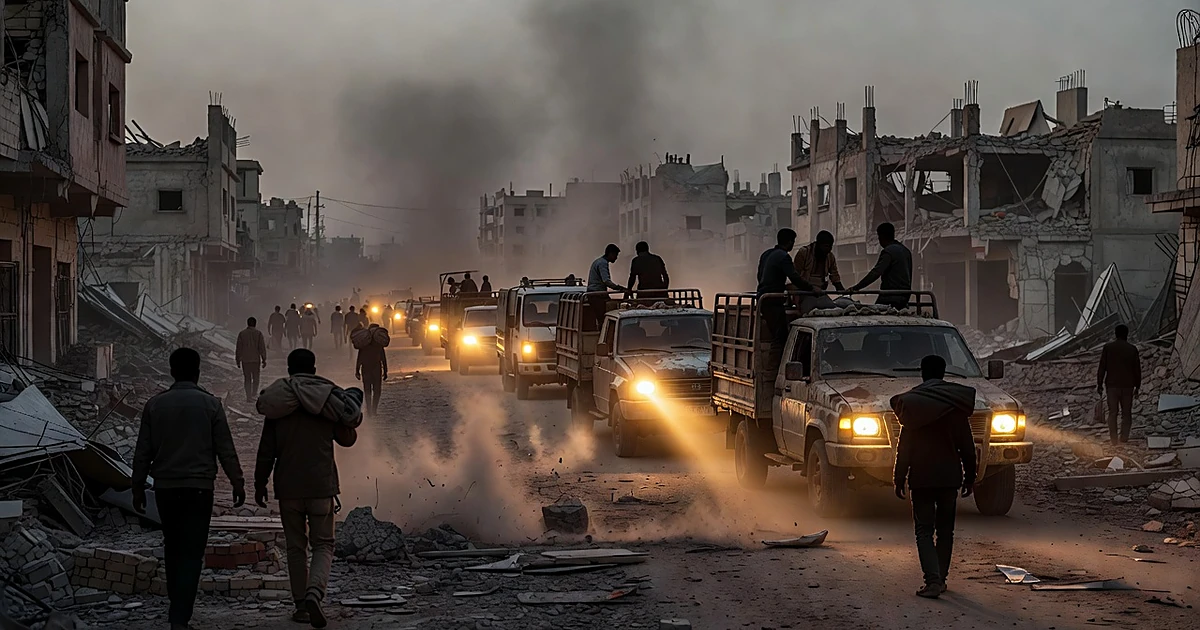
Hundreds of civilians finally fled the occupied Ukrainian town of Oleshky under a short ceasefire Melania Trump helped negotiate, after months of starvation, darkness, and failed earlier rescue bids.
The fourth and final plane carrying those residents landed in Gomel, Belarus, on Saturday, Ukrainian parliamentarian Davyd Arakhamia announced, with the group expected at the Ukrainian border later that day after a long route through occupied Crimea and Russia.
CNN reported that humanitarian teams from both Russia and Ukraine entered the ruined Kherson-region town once the temporary truce took hold, escorting people who wanted out and delivering aid to those who chose to stay. The ceasefire was set to expire Sunday.
Ukrainian authorities had warned that roughly 2,000 people, including 50 children, remained trapped in the heavily destroyed city after food and basic supplies ran out in September. Earlier attempts this year to open an exit path into Ukraine-controlled territory were rejected by Moscow at least three times.
First lady Melania Trump worked directly with Ukrainian and Russian leadership as the exclusive intermediary, initiating the talks that produced the local pause in fighting. Ukraine’s ombudsman Dmytro Lubinets said efforts to ease the crisis had been underway since late February, but progress accelerated only after her involvement.
That same pattern of quiet persistence has marked other moments in her public role, including when Melania Trump secured an earlier local truce that opened an aid path in the same occupied area.
Starvation forced the choice to leave
Oleshky has sat under continuous Russian occupation since April 2022. It sits near the Dnipro River opposite Ukrainian front-line positions, making any direct crossing impossible. The town was already battered when the Nova Kakhovka Dam collapsed in 2023, flooding the area and killing several hundred people. Evidence pointed to Russian responsibility; Moscow denied it.
Prewar population stood near 24,000. About 40 percent fled early when escape was still possible, according to the Institute for the Study of War. Those who remained faced months without reliable electricity, gas, medicine, or clean water.
Ukraine’s foreign minister Andrii Sybiha described the conditions earlier this month.
"People in temporarily occupied Oleshky are starving. There is almost nothing left to eat. Reports indicate that civilians are being forced to survive on grass and weeds, while medicines, clean water, electricity and medical care are increasingly out of reach. Children are trapped in these conditions too."
One resident who spoke to Ukrainian television, choosing to remain anonymous, put the human cost in plain words.
"We ourselves are already exhausted. It’s very hard. Constantly in the dark. If we were in good health, maybe we would have stayed longer, but now that’s it. We want to be with our children."
Another woman said she could not fly and would stay with her husband. Lubinets told those leaving that the decision to remain was their own choice and that officials would still push for some humanitarian aid to reach them.
Demining cleared the road, at a cost
The temporary truce went into effect Tuesday and expanded across the Kherson region. Demining of access routes began the same day. Both Russian and Ukrainian sides announced completion of that work on Thursday. Two people taking part in the clearing operation were killed.
Evacuation movement started Friday afternoon local time. Twenty-five buses with a combined capacity of 750 seats formed part of the operation, Lubinets said. Residents left by bus through occupied Crimea to Anapa in Russia’s Krasnodar region, then flew from Anapa airport to Gomel. From there, buses would take them to the Ukrainian border.
Arakhamia stated the outcome on Telegram once the last flight arrived.
"In just a few hours, all Ukrainian citizens evacuated from Oleshky, along with the Ukrainian delegation, will be on Ukrainian soil."
Exact headcount of those who left versus those who stayed has not been released by either side.
Lubinets himself traveled into the occupied town to escort residents, the first high-profile Ukrainian official described as openly entering Russian-controlled areas since the full-scale war began. Russia’s human rights commissioner Yana Lantratova appeared with him in the Russian-controlled part of Kherson on October 30 as they spoke with journalists.
Public attention on the first lady has swung between scrutiny of her schedule and recognition of concrete results, whether the focus is her decision to skip an Ireland visit or the quieter diplomatic work that produced this corridor.
Medical teams wait on the other side
Andriy Zhydenko, director general of the Chernihiv Regional Hospital, said medical staff stood ready at the border. Non-critical cases would move on to Kyiv. He warned that people who had been starving would need careful feeding and that the group included injuries, stroke survivors, and residents with limited mobility.
Zhydenko framed the arrival in direct terms.
"We’re waiting for people. There are people with injuries, stroke survivors, and those with limited mobility. For us, this day is a celebration, we are bringing our citizens home. All of my staff wanted to come here."
The short ceasefire also brought a pause in the near-constant Russian drone attacks on the Ukraine-controlled city of Kherson across the river. President Volodymyr Zelensky noted the calm in a Friday night address while repeating his demand that Russia end the war.
Separate diplomatic tracks continued in parallel. President Donald Trump’s envoy Steve Witkoff recently met Zelensky in Norway before traveling to St. Petersburg to see Vladimir Putin. Those talks covered possible future trilateral meetings even as Putin restated maximalist demands on territory and Ukrainian sovereignty.
Family security pressures remain part of the broader backdrop for the Trumps, including the extraordinary measures around Barron Trump living under heavy protection after foreign threats.
A narrow window that others could not open
International organizations and faith leaders had called for urgent action after Ukrainian officials raised the alarm in September. Prior channels produced little. Lubinets was blunt about the shift: things really started moving in September, thanks to Melania Trump.
The first lady had already played a role in securing the return of several Ukrainian children taken to Russia. This ceasefire extended that practical focus to civilians still trapped inside a front-line town that Russian forces treat as a forward position.
Her public standing has faced familiar headwinds, from coverage of approval ratings and fewer appearances to online reaction after a Rose Garden moment with the president drew extra attention. The Oleshky corridor stands apart from that noise: a measurable result for people who had been reduced to foraging.
The truce was always temporary. It expires Sunday. No extension has been announced. What remains is the simple fact that hundreds of Ukrainian citizens are moving toward home after years of occupation, a dam disaster, and a food collapse that left children among the trapped. Diplomacy that delivers an exit ramp for the starving is the kind of outcome that outlasts the news cycle.
When elite processes stall and civilians eat weeds, the first lady who opens a real corridor has already done more than another round of speeches.